Tuesday, August 09, 2016

Review: The Ups and Downs of a Gunner: My Life Story

Albert Figg has a story to tell, and it's a good one. His memoir, The Ups and Downs of a Gunner: My Life Story, is a quirky, no-nonsense look at how an ordinary man became caught up in an extraordinary time.

Born in Wiltshire, England, in 1920, Albert was the youngest of eleven children. His childhood was spent learning how to milk cows and harvest hay, frolicking in the fields picking blackberries and apples, going to school, and getting into mischief with his friends. But when Hitler came to power in 1933 and in the years that followed, Albert became intensely aware of the rumblings of war coming from Germany. And in February of 1939, to avoid being drafted, Albert enlisted with the Royal Artillery, 112 Field Regiment, of the Territorial Army.

During the war, Albert trained in preparation for the invasion of Europe, climbing to the rank of sergeant in less than three years. He and his crew landed on Gold Beach at Normandy on June 24, 1944, and would go on to be involved in the attacks on Hill 112 as part of the 43rd Wessex Division. Following his service in Normandy, Albert participated in Operation Market Garden and the Allied advance into Germany. After the war ended, he became part of the British Army of Occupation Rhine. He was discharged in Februrary of 1946.

The Ups and Downs of a Gunner also delves into Albert's post-war life. He details post-war Britain and the political upheaval that occured after the war, as well as his new role as a father and husband. In his later years after his children were raised and he retired, Albert focused on memorializing the 43rd Wessex Division and remembering the sacrifice of those who fought on Hill 112, a mission he still continues today at the age of 97.

What is most enjoyable about Albert's book is its folksy, down-to-earth style of storytelling. It's easy to imagine Albert telling you his tale while the two of you sit ensconced in wing-back chairs in front of a roaring fire on a chill English evening, with tea and biscuits close by. Albert is witty and charming in his descriptions of his life, and his anecdotes are vivid and at times, downright hilarious. Yet when the subject arises, Albert does not shy away from the horror of war.

This is a heartwarming, fun read about an Englishman's life before, during, and after World War II. Thank you, Albert, for writing your story.

For more information about Albert, please visit his website: http://www.albertfigg.co.uk/the-ups-and-downs-of-a-gunner/

Monday, June 06, 2016

D-Day - June 6, 1944

Today, 72 years ago, the world's largest invasion force hit the beaches and soared over the skies of Normandy. Thousands were killed. Thousands were wounded.

We remember them.

Below is a snippet of a Peanuts cartoon called What Have We Learned, Charlie Brown? (reviewed on the blog here) that shows Snoopy, Woodstock, Charlie Brown, Linus, Marcie, and Peppermint Patty exploring Omaha Beach and Normandy.


Thursday, May 26, 2016

Midnight in Berlin by James MacManus

Meaty historical fiction is an absolute treat to read. When it is infused with the details of that time period and seamlessly integrates story and history, then you know the author has succeeded in their job. And James MacManus is no exception with his latest novel.

Set in Berlin in the critical years of 1938-1939, Midnight in Berlin follows the life of British military attache Colonel Noel Macrae as he tries to navigate the choppy waters of dealing with not only Hitler's government, but his own.

When Macrae arrives in Berlin with his wife, Primrose, neither are particularly anxious to be in a Germany overtaken by Hitler. Macrae was a sniper during World War I, and he has no desire to participate in another war. However, he is no fool and he sees the truth behind Hitler's pontificating speeches. Hitler wants war and he will have war.

Unfortunately for Macrae, the British ambassador in Berlin believes negotiating peace with Hitler and following a policy of appeasement is the only way to avoid a war. Macrae bangs his head against the proverbial wall time and time again in trying to convince his superior and others in the embassy to open their eyes to Hitler's plans for the Sudetenland and Czechoslovakia. And though he is technically not a spy, Macrae finds himself playing the espionage game with Florian Koenig, a top general in the German Army (and Primrose's lover) who informs him of the Army's plans to overthrow Hitler. Macrae is walking a tightrope.

Things become even more complicated when Sara, a Jewish woman who works in the Gestapo's elite brothel, The Salon, asks him for his help in finding out what happened to her brother. Even though it's dangerous to be seen with her, he can't help but fall in love with her.

As the British government continues to appease Hitler and the months roll by with no peace in sight, Macrae becomes desperate for action and makes a choice that might seal everyone's fate.

The vast amount of research done for this novel is mind-boggling. At times, it reads more like a history of Germany in those years than a novel. In certain places, however, there was too much history and not enough story. Nevertheless, it wasn't a hardship to read these sections because they were written so well. But it did detract from the overall plot. The last quarter of the book also felt rushed, as if the author needed to hurry up and finish and didn't have time to write engaging scenes.

But what MacManus succeeds at, and admirably so, is showing the absolute diplomatic failure of the European governments - especially Great Britain. That they utterly failed to see who Hitler really was despite repeated warnings from those who could see the truth is maddening, especially in hindsight. But there were those, like Macrae, who accurately predicted Hitler's actions, and to see their warnings to their superiors discarded so easily is frustrating. Appeasement was indeed the order of the day, and we all know how disastrously that policy played out.

Midnight in Berlin is a terrific read, one that not only entertains, but educates. And that is the mark of a truly good piece of historical fiction.


Note: This review was done from the advance uncorrected proof. I did not receive any remuneration for this review.


Wednesday, January 27, 2016

International Holocaust Remembrance Day 2016

71 years ago today, the Soviet Army entered Auschwitz and liberated the camp. Today, the international community remembers this day.

Yad Vashem has a remarkable online exhibit called "The Anguish of Liberation as Reflected in Art 1945-1947."

From their website:

"This special on-line exhibition, based on the Yad Vashem Art Collection, features works created between 1945 and 1947 and attempts to investigate how survivors reacted to the liberation through art.
For most of these survivor-artists, the ability to paint again signified freedom and renewed independence. The choice of their art's subject and the grip on the pencil or brush symbolically restored a feeling of control, after years of helplessness. The act of painting represented a process of psychological rehabilitation through which they could synthesize the trauma."

One of the more powerful images is by Israel Alfred Gluck. He was held in Auschwitz and Buchenwald. 

"This page depicts the moment of liberation at Buchenwald: a soldier riding on an American tank is shown as the savior and is eagerly received by the prisoners, yet most of them are unable to even stand in order to welcome him. The artist signs the drawing with his name, accompanied by his prisoner number from Auschwitz."

 Never Forget.


View more of the exhibit here:

http://www.yadvashem.org/yv/en/exhibitions/art-liberation/index.asp


Sunday, December 27, 2015

Apologies

This blog has, unfortunately, fallen by the wayside. I have had a great deal of health struggles this past year and it has put me quite far behind in my reviews. Unfortunately, those health struggles are not going away as I have two chronic illnesses, so I'm learning to accept a new normal and to focus my limited energies on the things that are truly important to me. Writing about World War 2 history remains one of my passions, so I definitely have no plans to abandon the blog. 

If you sent me a book to review and I haven't done it yet, please accept my apology. I hope to get to all of them at some point. 

Thank you for understanding.

 I wish you a wonderful 2016!


Tuesday, November 03, 2015

2015 International Conference on World War II

The National World War II Museum in New Orleans never fails to produce an amazing line up of speakers and events every year for their International Conference on World War II. This year, the theme is 1945: To the Bitter End and it will explore some of the pivotal events of this last year of the war. The conference runs from November 19-21, 2015.


From their website:

"Our 2015 Conference explores the final year of World War II, from the Battle of the Bulge to the discovery of concentration camps across Europe to the dropping of atomic bombs on Hiroshima and Nagasaki, a time when Allied nations celebrated victory and their leaders sought to implement their postwar agendas."

If you can't make it to New Orleans (like me), then you are in luck: the museum live streams the conference for FREE. This means you can sit in the comfort of your home or office and watch some of the leading scholars of World War II speak about the events of 1945.

A full list of speakers and lectures, plus the link to live streaming, can be found here:

http://www.ww2conference.com/home/

If you missed last year's conference, (which focused on the events of 1944), you can watch it in its entirety here: http://livestream.com/nww2m/events/3632330

Make sure to mark your calendars. This is something you won't want to miss.


Saturday, August 15, 2015

Generation War (Unsere Mütter, Unsere Väter)

When this German miniseries on World War II came out in Germany in 2013, I was quite anxious to watch it. I knew it had generated some controversy, but I also knew I had to judge for myself. It just recently appeared on Netflix streaming, and I binge-watched all three episodes.

Generation War (Unsere Mütter, Unsere Väter) centers on five friends from Berlin who've been together since childhood: Wilhelm and his younger brother, Friedhelm, are in the Wehrmacht; Charlotte (Charly) just joined the German Red Cross as a nurse; Greta is a bartender with singing aspirations; and Viktor is a Jewish tailor.

The series follows the five friends from the summer of 1941 through the end of the war and shows how their lives intersect and dramatically change as the war drags on.

Both brothers serve on the Eastern Front, beginning with Russia. Friedhelm knows the futility of the war from the start and hangs on to his humanity until the war mercilessly grinds it out of him. Wilhelm, a lieutenant, does his duty even when he doesn't want to, but the senselessness of leading his men to slaughter becomes too much for him. Charly works at a field hospital and sees the war's gruesome toll on a daily basis. Greta, wanting to save her boyfriend, Viktor, begins an affair with a  Gestapo officer, one that will lead to her eventual destruction. And Viktor, after being held in a concentration camp, escapes from a train en route to Auschwitz and ends up embroiled with Polish partisans.

Not all of them survive, and those that do have changed so irrevocably by the war's end that they are a mere shadow of their former selves.

The acting is quite brilliant. I feel that the actors who played the two brothers (Volker Bruch and Tom Schilling) did an especially incredible job of portraying the relentless toll of war and how it fundamentally alters our perceptions of good and evil, moral and immoral.

Some of the reviews I read said it "whitewashed" Nazis crimes and made the central characters sympathetic. Two points to consider here. One, I don't believe it whitewashed Nazi crimes at all - there are several scenes that show just how horrific they really were and also shows the Wehrmacht's complicity in such crimes. Two, the fact that the central characters were sympathetic (and at times, they most certainly were not) is what a story needs to keep the audience intrigued. Not many people want to watch a movie with characters who are so despicable that you just want to throw the remote at the t.v. in disgust or turn it off altogether.

I also think there is a tendency for people to believe that any type of World War II movie that comes out of Germany cannot have main characters who are not fanatical Nazi ideologues because it's not "accurate." I dispute this notion. I don't believe that 100% of Germans were fanatics or subscribed to Hitler's ideology.  That is a statistical improbability, and we have historical evidence that proves otherwise. However, that the vast majority went along with the war is indisputable.

There were plenty of other characters who showed the hatred, racism, intolerance, and sadistic behavior of average Germans and soldiers alike. So all in all, I felt we were given all sides of the story.

A very strong point of the series: it shows how the constant brutality of war dehumanizes a soldier, no matter what side they're on. E.B. Sledge talks about this a lot in his memoir, With the Old Breed. He served in the Marines on Peleliu and Okinawa, two of the most brutal battles fought in the Pacific campaign. He started out with his humanity in full force and cringed at the inhumanity he saw his fellow soldiers participating in. For example, Marines would often take souvenirs from dead Japanese soldiers. But after awhile, Sledge found himself doing the same thing.

By the same token, the two brothers serving in the Wehrmact smack right up against this brutality. Freidhalm begins the war with a high sense of morality, appalled at what he sees going on around him, and determines not to participate in it. Yet two years later, after experiencing the horror of the Eastern front, he's turned into a hardened soldier, capable of killing on command.

Of course, this isn't limited to soldiers. Charly must cope day after day with wounded, dying soldiers to the point where, toward the end, she actually hinders some soldiers' healing process so they don't have to go back to the front.

I do have some quibbles. I was astonished at how they portrayed the Polish partisans as being so virulently anti-Semitic. Further research shows that this wasn't quite true, and I'm wondering at the filmmakers' decision on this.

What the series succeeds in, quite admirably, is to show how immensely war changes people. The carefree, happy group of friends from the first few scenes is a faraway dream. Those who survived and meet again after the war are a shell of their former selves, irrevocably different, and they will never view each other quite the same way again.

It's always interesting to see how other countries portray the war, and this experience was no different. I believe the filmmakers did an admirable job of portraying all sides of the German experience, and in this, they succeeded in achieving their goal: of starting a conversation about the war in contemporary Germany. With the generation who experienced this war fast disappearing, it's imperative that conversation continues.

For American audiences, this is a must see. It examines the war from a different perspective than the narrative we currently have, and deepens our understanding of not only how the war affected the common soldier, but how the Nazi ideology infected every segment of German society. This is its strength. While there were those who became profoundly disillusioned with Hitler's rhetoric, others believed in it up until the very end.

The series is currently on Netflix streaming.


Thursday, May 21, 2015

War Bonds: Love Stories from the Greatest Generation

Wartime brings out some of our strongest emotions, but arguably one of the most powerful is love. With the very real possibility of death hovering over them, men and women of the 1940s often rushed to get married before the soldier shipped off to war, or made a commitment to marry once the war was over. They often wrote ardent letters to each other full of dreams of the future. Those letters became the glue that kept them together when the fighting, the waiting, and the separation became too much.

War Bonds: Love Stories from the Greatest Generation by Cindy Hval brings many of those stories to life. A journalist, Hval gathered 36 stories from men and women across America and compiled them into this wonderful volume.

Each story features wartime photos of the couples, as well as photos of their lives together 70 years later. This is perhaps the most poignant feature of the book, to see how their marriages have lasted for more than half a century. They will be the first to admit that it certainly hasn't been a bed of roses, but has taken commitment, strength, courage, and devotion to stay together through thick and thin.

There's Jerry and Nancy Gleesing who married and were expecting their first child before he was sent overseas, shot down over Hungary, and taken prisoner by the Germans; Gene and Evie Fields who waited to marry until Gene came home, carrying a Purple Heart he earned from wounds received in Italy; and Dean and Betty Ratzman who met as college students on a blind date in 1943 and married in February of 1946. These are just a small sampling.

Included with each story is a snippet of relationship advice from the couple, and it is here that you can catch a glimpse into the truth behind their marriage's longevity.

War Bonds is truly a heartwarming read, one that will renew your faith in commitment and marriage itself.

Wednesday, March 25, 2015

The Spy with 29 Names

Sometimes, life really is stranger than fiction.

Juan Pujol was a Spaniard who created one of the most incredible espionage networks in Europe during World War II. His incredible tale comes to life in The Spy with 29 Names: The Story of the Second World War's Most Audacious Double Agent by Jason Webster.

Pujol was caught up in the Spanish Civil War and because of it, he knew fighting totalitarianism was to be his life's mission. A quick, sharp-witted man, Pujol decided to become a double agent, and he began spying for the Nazis in 1941, pretending to be in London while he was actually in Lisbon. And the Nazis believed him. Once he hooked the Nazis, Pujol approached Great Britain with his newfound "status" and convinced them to begin a massive espionage campaign against the Germans.

The British - astonished at first at how well Pujol had done for himself - had to be persuaded that he was authentic, and once they did, they brought Pujol and his wife to live in Britain. Then Pujol got to work. Along with the help of his MI6 "handler", a Spanish-speaker named Tomas Harris, Pujol created an elaborate network of spies all across England. The catch? Not one of them was real. All of the spies were fictional: Pujol and Harris had made them all up.

Pujol, who was known to history as the famed double agent "Garbo", and MI6 were so successful that they were actually able to divert German Panzer divisions away from Normandy. The success of D-Day would not have been possible without them.

That one man was able to concoct such amazing, convoluted tales and have the German High Command trust his words was nothing short of incredible. This is a terrific, fast-paced, riveting story, one that must be read to be believed.

Saturday, February 14, 2015

The Deserters by Charles Glass

The topic of deserters during war doesn't come up very often when we think about World War II. Yet the act of desertion has occurred in every war since time immemorial. Only one man was executed for desertion by the U.S. military during World War II.

Charles Glass tackles this little-known topic in The Deserters: A Hidden History of World War II. While the press release says it is a "breathtaking work of historical reportage", I tend to disagree. Yes, there were men who deserted in World War II (and, as I stated previously, in every other war throughout history). But Glass chooses to focus on only three soldiers who deserted and doesn't deliver a comprehensive overview of deserters as a whole. Instead, we're treated to stories of men of somewhat dubious character who made the choice to desert. I don't see three men as being representative of the nearly 50,000 U.S. servicemen who deserted and the nearly 100,000 British servicemen who deserted.

Still, it is a good starting point on this topic, and reading these men's stories is worth your time. (Glass is not a historian but a journalist, a fact to keep in mind when reading.) War is hell, as William Tecumseh Sherman so famously said, and it created broken men who could no longer handle the stress of combat and chose to flee. It is crucial to understand what drove these men to do what they did, and I'd like to see a more thorough study of what made a soldier stay as opposed to what made a man flee during World War II. Of course, studying desertion during the war is a mixture of psychological and historical methodologies, but it is definitely one worth pursuing.

Saturday, February 07, 2015

The War Dogs of World War II

My newest article for America in WWII magazine is on the war dogs of World War II. I had such fun researching this one and came across a plethora of anecdotes that were a joy to read.

Nearly all of the dogs that served in the war came from civilian families. Owners actually donated their pet dogs to the war effort. That is quite a sacrifice! Yet thousands of Americans did just that. I wonder if such a program would be successful today. Somehow I doubt it.

The issue will be available on newstands and in bookstores February 17.

Thursday, January 22, 2015

The Garden of Letters by Alyson Richman

One of the joys of reading historical fiction is in learning intriguing historical details. It's amazing how little-known facts can lead to an entire treasure trove of information.

That's one of the reasons I loved Alyson Richman's latest novel, The Garden of Letters. Set in World War II Italy before and during the German Occupation, the novel centers on Elodie Bertolotti, a gifted young cellist who becomes involved in the Italian Resistance movement. As the novel opens, Mussolini is still in power, and Elodie lives a quiet life with her parents in Verona. Music is everything to her - it shapes how she sees every aspect of the world.

Things change, however, when her father is savagely beaten by fascists, and suddenly, Elodie's world view becomes skewered. She becomes involved in the local resistance movement as a staffetta. But instead of using a gun to fight her battles, she uses her cello, hiding secret codes within her music. She passes messages on to local resistance members and finds herself transforming from a girl into a woman, a woman who sees the destruction of her beloved country and cannot sit idly by and watch. But the deeper she becomes involved, the more dangerous it becomes, and when the Germans occupy Verona, Elodie must rely on all her courage to survive.

It is Elodie that makes this novel such a treat to read. Richman's characterization of her is full and rich as she expertly shows the symbiotic relationship between Elodie and her beloved music. Richman's descriptions of Elodie playing her cello are impeccably crafted, pulling the reader fully into Elodie's world.

The inner workings of the Italian resistance movement in Verona are fascinating and Richman uses real personalities in the novel. Her historical detail isn't heavy-handed, but deftly wielded to create a vibrant story alive with the feel of the time.

Beautifully written, The Garden of Letters is a wonderful read and a must for lovers of World War II fiction.


Sunday, December 07, 2014

My Pearl Harbor Scrapbook


Today marks the 73rd anniversary of the Japanese attack on Pearl Harbor. Hundreds of books have been written on the subject, but My Pearl Harbor Scrapbook by Bess Taubman is unique among them all.

This beautiful book is laid out in a scrapbook format and includes the history of that fateful day through the use of photos, maps, telegrams, newspaper articles, stamps, and memorabilia from the war. This is history come to life. Eschewing page after page of nothing but text, this book seeks to educate through the use of a visual kaleidoscope of images. And of course, the pertinent facts of that fateful day are included but in such a way as to seamlessly blend with the imagery.

Simply put, it's gorgeously done, and a delight to the senses. Here is just a sampling of what you'll find inside:


I highly recommend this book to any World War II enthusiast, whether you are a scholar or a hobbyist. Even if you think you've read enough books on Pearl Harbor, you'll want this one for the stunning collection of WW2 memorabilia alone.

And because it is Pearl Harbor Day, here's a story from the morning that led the U.S. to enter World War II.

America's First Air Hero's of WWII  or "Just An Easy Day"
By Bess Taubman,
Author of My Pearl Harbor Scrapbook 1941

On the eve of December 6th, Lieutenants Kenneth M. Taylor and George S. Welch, dressed in tuxedos, attended a formal dance at the Officer's Club at Hickam Field. They left around 11 p.m. and drove back to the Bachelor's Officer Quarters at Wheeler Field. The usual Saturday night poker game at the BOQ was in full swing so they sat in to play. Welch turned in early. Close to 4 a.m. a weary Taylor left the game to hit the sack thinking Sunday would just be another easy day.

The men in the BOQ were suddenly awakened the morning of December 7th, by the sounds of roaring planes and loud explosions. Someone yelled "We're under attack!" Taylor, still in his tuxedo pants and a skivvy shirt, ran to the window and saw clouds of smoke and fire rising from the twisted wreckage on the flight line where the squadron's fighter planes were parked wingtip to wingtip for anti-sabotage protection -- indeed an inviting target for Japanese planes. He met up with Welch who had just called the Haleiwa auxiliary airstrip on the North Shore where their squadron was stationed. Told there was no damage at the base, he ordered all aircraft fueled and armed ASAP. Within minutes they were in Taylor's Buick speeding up to Haleiwa.

Taylor and Welch took off in their Curtiss P-40 fighter planes, climbed to 3,000 feet and flew towards Pearl Harbor. Seeing a formation of Japanese planes circling over the Marine air base at Ewa, they charged in and quickly shot down four enemy planes and damaged two others.
Having expended all their ammunition and low on fuel, they flew back to Wheeler to re-arm. Wheeler Airfield came under attack by a group of Japanese "VAL" dive bombers. Welch was the first to take off. Taylor quickly followed and as he was gaining altitude he got on the tail of a "VAL" and began firing. However, he was wounded as his P-40 came under fire from behind with a "VAL" on his tail. Taylor managed to watch his pursuer shot down by Welch who also shot down another of the attackers for his fourth kill of the day. With his plane still flyable, Taylor continued chasing after other enemy planes until all his ammo was expended. He returned to base still wearing his tuxedo pants.

Both Army pilots were awarded the Distinguished Service Cross for their outstanding acts of heroism on a Sunday morning that turned out to be "not just an easy day" after all.
© 2014 Bess Taubman, author of My Pearl Harbor Scrapbook 1941

Author Bio
Bess Taubman, 
author of My  Pearl Harbor Scrapbook 1941, combines her unique talents as writer, designer and publisher creating dynamic, educational products about historical subjects. She has been writing about the Pearl Harbor story for over twenty years. Presenting the reader a unique way to learn about complex subjects, Ms. Taubman is helping to reshape the way historical information is introduced with colorful vivid story lines. This is her first book. She lives in Phoenix, Arizona with her husband and daughter.

For more information please visit http://mypearlharborscrapbook.com, and follow the author on Facebook and Twitter.

Monday, November 17, 2014

Watch FREE Live-Stream of International Conference on WWII - Dec. 4-6, 2014

The National World War II museum in New Orleans, Louisiana, will once again live-stream their amazing conference for FREE. This year's theme is 1944: Beyond All Borders, and it promises to be just as good as last year.

Here's a brief description of the conference:

"The 2014 International Conference on WWII, 1944: Beyond All Boundaries, will cover the buildup and preparations for the explosive summer of 1944, the Allied advances on all fronts, and the eventual stalling of that momentum in the fall. Top scholars in the field will explore key battles, personalities, and controversies—including why, despite great success, the Allies were unable to achieve victory by year’s end."

Noted speakers include Rick Atkinson, Antony Beevor, and Dr. Gerhard Weinberg.

Check out the museum's website for a full schedule and to see a list of all the talks. Then make sure to mark your calendars!


Wednesday, November 12, 2014

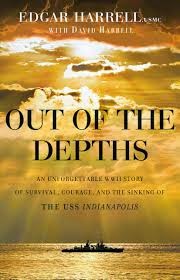
Review: Out of the Depths by Edgar Harrell

Sometimes, we forget the horrors of war. We forget that the veterans we rightly praise as heroes went through hell, time and time again.

This is certainly true for Edgar Harrell, a U.S. Marine who survived the sinking of the USS Indianapolis in late July 1945. Together with his son, David Harrell, Edgar relates his unbelievable story in Out of the Depths: An Unforgettable WWII Story of Survival, Courage, and the Sinking of the USS Indianapolis.

Much has been written about the USS Indianapolis as one of the worst naval disasters in U.S. history, but Edgar's story truly brings the human element to life. When the ship was torpedoed by a Japanese submarine, Edgar was sleeping on the deck of the ship. The blasts instantly woke him and before long, he, along with hundreds of other men, had to abandon the sinking ship.

What followed in the next four days could only be the stuff of nightmares. Plagued by unbearable thirst, the sun's harsh rays, and hypothermia, many men went delirious or saw hallucinations and swam away to their deaths. Others succumbed to their need for water and drank the poisonous salt water, resulting in their tormenting deaths. Shark attacks, lack of fresh water and food, dehydration, injuries, and utter exhaustion took many others.

With vivid imagery, Edgar describes the heartbreaking ordeal of watching his comrades die, of trying to keep his fellow friend and Marine, Miles Spooner, alive, of his determination to survive. Throughout it all, his faith in God kept him going, and others, as well. It was this unshakable faith that enabled him to never give up hope.

Rescue finally came, a miracle in itself,  and Edgar and his fellow survivors began the arduous journey of recovering from their experience. 317 out of 900 men survived. Unfortunately, the secrecy and deception surrounding the incident haunted them for years afterwards, and it would be decades before the truth was finally told.

This is an intimate, highly readable story. In fact, it would be quite easy to imagine Edgar telling you his tale while sitting across from you at a table in your local coffee shop. His is a gentle voice, one that can move you to tears of happiness or tears of pain. Yet over and over, the one striking element of his story is his overwhelming gratitude to the Lord for sparing him and for allowing him to share his faith with his shipmates.  It's this faith that sustained him through his ordeal, and this faith that has enabled him to live a full life blessed with a loving wife, children, grandchildren, and great-grandchildren. Though the memories of this nightmare still remain (he has never again stepped foot in the ocean), Edgar has found peace.

A highly readable, well-written personal account, Out of the Depths is as inspiring as it is informative.

Tuesday, November 11, 2014

Veterans Day 2014

A few weeks ago, hubby and I went to a local grocery store to buy a few things. An elderly veteran stood outside, selling poppies for the Disabled American Veterans. He looked grizzled and cranky and, frankly, plain grouchy. And no wonder. No one was stopping to buy his poppies.
I didn't have any cash on me, so I figured I'd wait to buy a poppy from him until I got some money inside the store. After we finished shopping, we went back outside and I walked up to the veteran, handing him the money. You would not believe the smile that lit his face. 
"I'd like to buy a poppy," I said.
He beamed at me. "You can have as many as you want!"
That smile changed his entire demeanor, and I suddenly realized what a small act of kindness can do for people, especially a small act telling that veteran you will remember him and his comrades.
Today, I wear that poppy and I remember him and the rest of the veterans, past and present.

Thank you for allowing me to live in freedom. I will never forget.

Friday, November 07, 2014

The Illustrated London News

If you're interested in primary resources on World War I and World War II, then it's a safe bet you'll love this new resource from Christie's in London: The Illustrated London News. Though the sale has passed, you can still view the e-catalogue with a listing of the works and descriptions.

From the press release:


"Christie’s is proud to announce that it will offer works from the collection of The Illustrated London News in the Interiors sale on 7 October 2014. The works on offer from Illustrated News Limited (ILN) include original illustrations and artworks from the world’s first illustrated weekly news magazine, The Illustrated London News, published from 1842 to 2003 and The Sphere, a weekly illustrated newspaper published from 1900 to 1964. The illustrations offered from the collection, the majority of which were reproduced in print, highlight the role that these publications played in chronicling through imagery British history in the 20th Century.

From their coverage of royal events including the Royal wedding of Queen Elizabeth and Phillip Mountbatten, to the publications’ coverage of WWI and WWII, and The Festival of Britain, the illustrations offer a diverse and fascinating insight into the way The Illustrated London News documented key events of the time to its British and North American readership. The sale features works on paper by leading artists and illustrators of the period, Bryan de Grineau, Steven Ward, Fortunino Matania and several oils by Terence Cuneo, all of whom worked for the publications."

 A few of the illustrations:

The value of carrier pigeons during World War II - by Bryan De Grineau, 1941

Charles Edward Turner (1883-1965) - The last tense minutes of the "Ark Royal": A destroyer hitches alongside the sinking warship, 1941.


Friday, June 13, 2014

Review: The Hotel on Place Vendome

Narrative nonfiction is becoming a favorite of mine to read. It tells a story in much the same way as a novel, only this story is real. Some really great narrative nonfiction in the history realm include Unbroken by Laura Hillenbrand and Priscilla by Nicholas Shakespeare (both reviewed here on the blog). I'm very pleased to add another one to the list: The Hotel on Place Vendome: Life, Death, and Betrayal at the Hotel Ritz in Paris by Tilar J. Mazzeo.

Since 1898, the Hotel Ritz in Paris has been the place where heads of state, cultural icons (writers, painters, actors), journalists, and even royalty have flocked. In the 1920s, Ernest Hemingway and F. Scott Fitzgerald frequented the Ritz, as did Winston Churchill and Charles de Gaulle.

But it was when the Occupation of Paris started in 1940 that things at the Ritz became quite interesting. The hotel was owned by Swiss-born Marie-Louise Ritz (she and her husband founded the Ritz in 1898) and despite her loathing for the Third Reich, Marie-Louise kept the hotel open rather than have it requisitioned by the Germans and losing it altogether.

German Reichsmarshall Hermann Goring took up residence in the Ritz as did numerous other German officials and military brass. Leading members in Parisian society, including Coco Chanel, still lived at the Ritz, though their regular luxury rooms were given to the Germans. Suddenly, the hotel became a seething hotbed of espionage and collaboration. Some of the generals involved in the plot to assassinate Hitler had their talks at the Ritz bar (and the bartender passed messages for them). French actress Arletty carried on a very open affair with German officer Hans-Jurgen Soehring. Members of the staff were involved with the French Resistance, and more than one room hid Jews and others the Gestapo were keen to find.

When Paris was liberated, the Ritz again underwent a transformation as did the entire city of Paris. Reprisals were swift and unrepentant. Women who had become "horizontal collaborators" often had their heads shaved and were paraded in the street. Arletty, even though she was a famous actress, did not escape retribution, either, though details are scarce as to what, exactly, she endured.

The Ritz was occupied again, but this time, it was under the Allies - specifically the Americans. As an official war correspondent, Ernest Hemingway returned triumphantly to the Ritz ahead of his friend and sometime rival Robert Capa, the famous photographer. Here, Hemingway indulged in alcohol and broke his marriage vows. Capa had his affair with Ingrid Bergman at the Ritz, and Coco Chanel was investigated for possible collaboration with the Germans (some thought she might be a Nazi spy), though her tangled relations with high British officials (she called Churchill friend) meant the allegations against her were never proven. Marlene Dietrich caused mischief between Hemingway's ex-wife and her new lover, a U.S. general, and enjoyed every minute of it. A top-secret Allied team even used the Ritz as their home while they sought to discover if the Germans had learned how to split the atom.

After the war, the Ritz started to fall out of favor as Hollywood became the place to be in the world, though the Duke and Duchess of Windsor were guests here while the Duke made plans to usurp his niece, Elizabeth, from the throne (the Duchess of Windsor, Wallis Simpson, effectively took care of his plans by embarking on a torrid affair with another man. The resulting scandal finished his ambitions.).

And, years later, after the Ritz had fallen into disrepair, an Egyptian businessman named Mohamed Al Fayed bought the hotel and completely renovated it. In 1997, his son, Dodi, and his girlfriend, Diana, the Princess of Wales, were at the Ritz  the night of their deaths.

Tilar J. Mazzeo does a lovely job of sweeping you into the history of this hotel. It is a history so rich with large personalities that reading the innermost lives of these people is an absolute pleasure. Her writing is rich and engaging, and peppered with such authentic, period detail that it is hard to switch back to reality after being buried in the book's pages for any length of time. That is the mark of a truly good book.

So much happened in this hotel during World War II, so many lives intersected, that it would not be a stretch to say that the Hotel Ritz played an integral role in the framing of modern Europe politically and culturally.

The Hotel on Place Vendome is a book for a wide and varied audience - those interested in World War II certainly, but also for those interested in Paris as a cultural center from the 1920s through the 1950s, and in the Ritz in particular.

I am in awe of the research involved in this endeavor, and Tilar J. Mazzeo deserves high praise for producing such an outstanding piece of narrative history.


Friday, June 06, 2014

70th Anniversary of D-Day

70 years ago, the biggest invasion force in history stormed the beaches of Normandy, France. Thousands died. Thousands were wounded. And thousands survived to keep on fighting.

May we remember their sacrifices always.
.

Monday, May 26, 2014

Memorial Day

As I sit here on my couch and gaze outside at the beautiful spring morning, a mourning dove coos, my Snoopy flag wafts gently in the breeze, and my two cats drowse under my chair.

There is no gunfire erupting, no house-to-house combat, no tanks rolling down the street, no riots.

It is calm. Peaceful. Serene.

This is what freedom looks and sounds like.

And men and women fought and died so that I may enjoy it and live my life in such a way as I see fit.

To those who fell in service to their country, sacrificing their lives, I say, Thank you. I will never forget.