
Tomorrow, June 6, is the 69th anniversary of D-Day. Thanks to the miracle of Twitter, you have a terrific opportunity to watch D-Day unfold in real time through the viewpoints of seven different 'characters.'
Check out the site here and relive history!
http://dday7.channel4.com/
Wednesday, June 05, 2013


Friday, May 24, 2013

Tuesday, May 21, 2013
Cook Tojo's Goose!
Apologies for the lack of posts here at The Best of World War II. Life has a way of shoving fun things like this to the back of the pile. I've been busy working on a lot of writing projects, including gathering research for my upcoming book on the POW camps in Nebraska during World War II.
So for today, I wanted to showcase a few of the funnier World War II propaganda posters. You have to love how completely entwined the advertising industry was with the war itself.


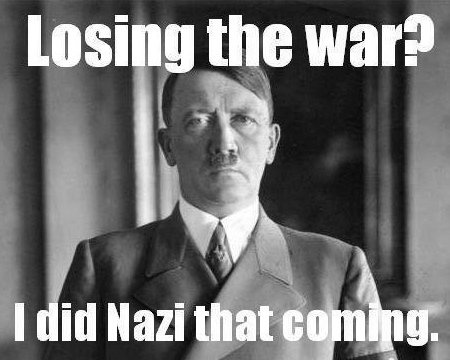
And, of course, a modern-day pun.

So for today, I wanted to showcase a few of the funnier World War II propaganda posters. You have to love how completely entwined the advertising industry was with the war itself.


And, of course, a modern-day pun.
Tuesday, March 26, 2013
"The Ducktators" - 1942
Cartoon studios created some terrific propaganda pieces during World War II. Posters featuring Mickey Mouse and Donald Duck urged people to get in the fight, buy war bonds, and keep their morale high.
Cartoons were also a great medium to get the message across. The one featured below, "The Ducktators", is from 1942 and tells the story of three "ducktators" - i.e. Hitler, Mussolini, and Tojo. The parody is spot on, and though by today's standards, some of it could be considered racist, it is definitely a product of its time.
Enjoy.
Tuesday, March 12, 2013
BBC Documentary: Nazis: A Warning from History
Though it was made in 1997, the six-part BBC documentary, Nazis: A Warning from History should be required viewing for not just World War II history buffs, but everyone. I don't say this lightly because "required" is a loaded word, and what one person believes should be required is another person's propaganda.
 But I will make an exception for this.
Laurence Rees wrote and produced this series, and if you know who Rees is, you'll realize you're dealing with an expert in World War II history. In short, he's brilliant. In addition, Sir Ian Kershaw, one of the most noted historians on the Third Reich, was the historical consultant. What does this mean? It means you will get an objective, honest, no-holds-barred look at the Third Reich from two men who know its history inside and out.
Broken down into six parts, this documentary takes an in-depth look at how the Nazis came to power in Germany, the structure of their government (very disorganized), their relentless propaganda, Hitler's bizarre hold on everyone from children to high-ranking Nazi officials, the origins of the Final Solution, and how Germany became a racist state.
Archival footage, photographs, and recordings of Hitler's speeches sometimes make for hard viewing, but it is necessary. The series also draws on Nazi documents that were discovered in Russia after the fall of the Soviet Union that offer further damning evidence to Nazi atrocities.
Survivors of the Nazis' brutality are interviewed, but it is the interviews with former Nazi party members, Wermacht soldiers, SS men, and even one of Hitler's secretaries that make this a truly original piece of documentary history. Though years have passed, many still justify their behavior, and it is fascinating to see how some skirt the question of responsibility.
One of the conclusions drawn from this documentary is that ordinary Germans were allowed to undertake and express sadistic fantasies against other human beings simply because the very morality of their government not only did nothing to stop it, but encouraged it. When the moral framework of a society disintegrates, those who wish to exercise their dark sides have free reign. Those who want to stand up against it must have incredible courage to do so.
But herein lies the question that continues to plague us all - how could such a cultured nation stoop to such horrors? My theory: Because they allowed the collapse. Indeed, it was easier to let the State do the thinking for them then to think and judge for themselves. Critical thinking skills disappeared as they allowed themselves to be swayed by propaganda and hero worship of a man who sought to control them. They voted to end their democracy, and that is exactly what happened.
What the series does is ask a very important, simple question: Could this happen again? The answer is an unequivocal yes. To this day, despite the mountains of evidence to the contrary, we have those who continue to deny the Holocaust happened, downplay its severity, point to ridiculous Jewish-Bolshevik conspiracies, or continue to harbor anti-Semitism. This is why the Nazis are a warning from history, as this documentary so ably shows, and this is why we can never forget how and why they were able to create hell on Earth.
For those interested in viewing this documentary, it is available on YouTube or on the website, www.documentaryheaven.com
But I will make an exception for this.Laurence Rees wrote and produced this series, and if you know who Rees is, you'll realize you're dealing with an expert in World War II history. In short, he's brilliant. In addition, Sir Ian Kershaw, one of the most noted historians on the Third Reich, was the historical consultant. What does this mean? It means you will get an objective, honest, no-holds-barred look at the Third Reich from two men who know its history inside and out.
Broken down into six parts, this documentary takes an in-depth look at how the Nazis came to power in Germany, the structure of their government (very disorganized), their relentless propaganda, Hitler's bizarre hold on everyone from children to high-ranking Nazi officials, the origins of the Final Solution, and how Germany became a racist state.
Archival footage, photographs, and recordings of Hitler's speeches sometimes make for hard viewing, but it is necessary. The series also draws on Nazi documents that were discovered in Russia after the fall of the Soviet Union that offer further damning evidence to Nazi atrocities.
Survivors of the Nazis' brutality are interviewed, but it is the interviews with former Nazi party members, Wermacht soldiers, SS men, and even one of Hitler's secretaries that make this a truly original piece of documentary history. Though years have passed, many still justify their behavior, and it is fascinating to see how some skirt the question of responsibility.
One of the conclusions drawn from this documentary is that ordinary Germans were allowed to undertake and express sadistic fantasies against other human beings simply because the very morality of their government not only did nothing to stop it, but encouraged it. When the moral framework of a society disintegrates, those who wish to exercise their dark sides have free reign. Those who want to stand up against it must have incredible courage to do so.
But herein lies the question that continues to plague us all - how could such a cultured nation stoop to such horrors? My theory: Because they allowed the collapse. Indeed, it was easier to let the State do the thinking for them then to think and judge for themselves. Critical thinking skills disappeared as they allowed themselves to be swayed by propaganda and hero worship of a man who sought to control them. They voted to end their democracy, and that is exactly what happened.
What the series does is ask a very important, simple question: Could this happen again? The answer is an unequivocal yes. To this day, despite the mountains of evidence to the contrary, we have those who continue to deny the Holocaust happened, downplay its severity, point to ridiculous Jewish-Bolshevik conspiracies, or continue to harbor anti-Semitism. This is why the Nazis are a warning from history, as this documentary so ably shows, and this is why we can never forget how and why they were able to create hell on Earth.
For those interested in viewing this documentary, it is available on YouTube or on the website, www.documentaryheaven.com
Wednesday, January 30, 2013
World War II Paperless Archives
To any historian, there's nothing quite like primary documents to get the heart pumping in excitement. Sometimes getting to those primary documents is a chore, especially when you're nowhere near any federal archive or library.
That's where it's handy to let someone else do the work. BACM Research - PaperlessArchives.com compiles a nice selection of World War II declassified government documents, all on a handy CD.
Here's just a small list of what you can find there:
Prices range from around $10 per CD, and you can also purchase complete sets at a discount. No matter which way you look at it, it's a heck of a deal, and just might save you a trip to the National Archives.
That's where it's handy to let someone else do the work. BACM Research - PaperlessArchives.com compiles a nice selection of World War II declassified government documents, all on a handy CD.
Here's just a small list of what you can find there:
- FBI files on Adolph Hitler
- Artwork done by U.S. Navy war artists for D-Day
- Winston Churchill correspondence
- Military field manuals
- German U-Boat captured documents
Prices range from around $10 per CD, and you can also purchase complete sets at a discount. No matter which way you look at it, it's a heck of a deal, and just might save you a trip to the National Archives.
Wednesday, January 23, 2013
Antony Beevor's The Second World War
Throughout his career, noted British historian Antony Beevor has certainly done his best to capture the truth of war. He's extensively covered the European side of the war, including Stalingrad, Berlin, and Paris following its liberation.
 With the massive scope of World War II, however, Beevor certainly had his work cut out for him, yet there is no doubt that he delivered with The Second World War. It's mammoth, coming in at nearly 800 pages, and has a bibliography that's a treasure trove for any historian of World War II.
This is mostly a military history of the war rather than a social one, though Beevor includes fascinating tidbits from numerous points of view. Beevor starts with the first few months before the war in 1939, when Hitler was planning his invasion of Poland, and takes us all the way through to September 1945 and Japan's defeat.
Make no mistake about it - this is a dense book. But its chock full of details, battle tactics, personalities, and just about everything in between. Beevor devotes nearly equal time to both the European and Pacific Theaters of war. His prose isn't heavy or plodding, but highly readable. His writes of the common soldier, the politician, and the generals, weaving a solid narrative filled with tidbits of information that truly make history come alive. For example, when Hitler heard of the German surrender at Stalingrad, he apparently stared into his vegetable soup. One wonders what he saw.
Beevor's discussion of the Soviet war with Finland is particularly jarring, shedding light on a conflict that tends to disappear within the larger narrative of World War II. Likewise, he doesn't blink in describing the gruesome atrocities committed by the Japanese, Soviets, and Germans alike.
Don't be dissuaded by the thickness of this book. It's well worth your time, and though this may be a cliche to say, it belongs on every World War II historian's book shelf.
Wednesday, December 12, 2012
Christmas at the Front


 |
| WW2-era Christmas Card |
Merry Christmas!
Friday, December 07, 2012

Sunday, November 11, 2012
Veterans Day 2012

Thank you to all the veterans, past and present, who have served.
Your sacrifices will never be forgotten.
Wednesday, October 17, 2012
Charles Schulz and World War II
The creator of the famous comic strip, Peanuts, once served in the U.S. Army during World War II.
 This service forever changed his life, molding him from a shy young kid into a confident, strong man. His time in the army also served as material for many of his later comic strips. Charlie Brown epitomized Schulz's angst in basic training and Snoopy showed what it was like to be an infantryman in several D-Day tribute comics.
 You can read all about Schulz and his WW2 experiences in my article feature in the December 2012 edition of America in WWII magazine, available on newsstands now!

Friday, August 03, 2012
Flight from Berlin by David John
I'm always very pleased when a first-rate World War II thriller shows up on the "New Releases" list, but I'm every more pleased when the book delivers on its intended promise.

Flight from Berlin by David John does just that.
Although the 1936 Berlin Olympics have been covered in fiction before (see Garden of Beasts by Jeffery Deaver for another engrossing read), John's debut novel takes a slight twist in featuring one of the Olympic athletes as a main character. Spoiled and maybe too keen on partying, Eleanor Emerson is an Olympic swimmer en route to the Olympics when she gets thrown off the team for getting drunk and dancing all night. She is then given the job of being a journalist covering the games, and she meets English journalist Richard Denham.
Denham has lived in Berlin for several years. His ex-wife and young son live in Britain. Denham has seen the seedy underbelly of Nazism and he senses there's a story to be found when he discovers that Hannah Liebermann, a talented fencer, is the only Jewish athlete on the German Olympic team. Further investigation reveals that the Nazis are threatening to harm Hannah's family if she doesn't participate.
Denham and Eleanor team up to uncover the story, and in the process, discover that Hannah's father has a dossier on Hitler that the head Nazis want back very badly. What they are willing to do to get it back puts Richard and Eleanor on a collision course with evil itself.
John places you right smack in Berlin in 1936, and his vivid, sensory descriptions and flawless narrative deliver a terrific read. Also enjoyable are his inclusions of a Zeppelin airship, the Hindenburg, real-life personages - Martha Dodd, daughter of U.S. Ambassador William Dodd, plays a major role - and spot-on historical detail.
I look forward to more great reads from David John, and highly recommend Flight from Berlin for its fast-paced action, gripping detail, and well-rounded characters.
*Disclosure. I received a copy of this book from the publisher for review purposes only.
Tuesday, July 31, 2012
John Huston Documentary: "Let There Be Light"
Post traumatic stress disorder was not given a name until sometime in the 1980s. But that didn't mean veterans returning from wars were not subject to psychological trauma.
Even in the 1940s, this trauma was recognized, but kept hush-hush. Renowned film director, John Huston, made a documentary on this subject in 1946. However, the U.S. Army blocked its release, and it was not revealed to the public until 1980. By that time, however, the quality of the film itself was in such bad shape that watching it was impossible.
Thanks to the National Archives, the film was fully restored and can be watched for a limited time at this link.
http://www.filmpreservation.org/preserved-films/screening-room/let-there-be-light-1946
This is a no-holds barred look at the psychological trauma suffered by World War II veterans, and further shows how we need to remember what these brave men and women went through. That the U.S. Army banned its release for so many years, however, is not only telling, but shameful.
Friday, July 13, 2012
Free Lectures on World War II
The Harvard University History Department and Extension School has now made it easier for you to learn about World War II without having to pay a dime.
Free video lectures (or audio - your preference) are now available through their website. Taught by Charles S. Maier, PhD, Leverett Saltonstall Professor of History, Harvard University, this course begins with the end of World War I and goes all the way through to the origins of the Cold War.
Here is the full link:
Enjoy!
Monday, July 09, 2012
The Sentinels: Fortunes of War
Gordon Zuckerman's first book in his Sentinels trilogy, Fortunes of War, starts off a unique series that focuses on the Six Sentinels, six graduates - men and women - of an elite California economic doctoral program in the 1930s who uncover a plot by German industrialists to finance the Third Reich by squirreling away hundreds of millions in illegal war profits.

It's an intriguing premise, to be sure, but it starts off a little slow. The pace picks up somewhat and Zuckerman delivers on the promised action and suspense. The six main characters - the sentinels - each have excellent connections both financially and through their families, making it possible for them to infiltrate the upper echelons of European society. Danger dogs their every step, however, as they try to stop the outbreak of World War II.
Zuckerman knows his stuff, and well he should considering he is a graduate of Harvard Business School. He's also studied banking, international finance, and history, making him the perfect candidate to tell this story. It's definitely a different story than the typical World War II fare and should find a ready audience.
Thursday, June 14, 2012
The Hidden Legacy of World War II

We have perpetuated a myth, and that myth is this: that soldiers of World War II returned home from war, resumed their normal lives, and never had any problems.
This is not a myth for some. There were those who adjusted to civilian life just fine. But for too many, this was not the case, and for too long, we have ignored their stories.
In The Hidden Legacy of World War II: A Daughter's Journey of Discovery, Carol Schultz Vento gives us an intimate, in-depth look at the deep emotional and psychological wounds suffered by combat veterans of the war. Her father, immortalized in the 1960 movie, The Longest Day, was Arthur "Dutch" Schultz, a paratrooper in the 82nd Airborne Division who parachuted into Normandy on D-Day.
Growing up, Carole suffered through her father's drinking, his inability to hold down a job, and the endless fights between him and her mother. Little did she know that several other children of World War II combat veterans were suffering the same fate. Yet no one talked about it, least of all the veterans themselves. The U.S. Army told many of them they were suffering such emotional turmoil because they'd "had a difficult childhood" or were "psychologically weak." No one seemed to understand, or wanted to understand. Some soldiers tried to relieve the constant pain through dramatic means like lobotomies. Others used alcohol and drugs. Still others committed suicide.
Yet we do not hear about this side of the war. We have sanitized World War II and in doing so, we have turned these men into something they're not - supermen. Are they heroes? Unquestionably. But they are also human, and their suffering is very real.
Though not nearly as many studies have been done on World War II veterans and PTSD as have been done on Vietnam veterans and the wars of today, Vento has done her research, and it shows in her well-written narrative. We read of a daughter's frustration and fear, insecurity and helplessness, all emotions experienced by several other children of World War II veterans as documented in Vento's book.
It's a powerful book and can and should be read in conjunction with Thomas Childers' work on the subject, Soldier from the War Returning: The Greatest Generation's Troubled Homecoming from World War II.
As William Tecumseh Sherman said, "War is hell." Yes, even World War II, the "Good War" was hell. We must never forget this. For many WWII combat vets, they've continued to endure the hell of war for more than sixty years. While we must continue to honor them, we also must continue to chip away at the myth of the stoic warrior who was unaffected by the horrors of war. We do them a disservice when we refuse to acknowledge the post-war difficulties they endured, and they do not deserve that. Instead, they deserve our thanks, our gratitude, and most importantly, our acceptance of their humanness.
_____________
For more information or to read other stories of children of the Greatest Generation, visit Daughters of D-Day, a site started by Carol and another daughter of a D-Day veteran.
Wednesday, June 06, 2012
68th Anniversary of D-Day

The Invasion of France began on this day 68 years ago. It has been documented in films like The Longest Day and Saving Private Ryan. But no one will ever be able to accurately depict the horror of charging up those beaches. Only the brave men themselves who partook in this historic moment will ever know the truth of those seconds, those minutes, those hours of fighting.
But we must remember them, both those who died and those who lived. Both made sacrifices. Both endured terror. All of them deserve our respect and our gratitude.
Monday, June 04, 2012
Website Review: WWII Archives
If you're looking for an absolute treasure trove of historical documents, photographs, and lots and lots of other information on World War II, the WWII Archives website should be a required stop on your World War II research journey.
Their mission statement reads as follows:
"Sixty years have past since the end of World War II and, as time goes on, the commitment and sacrifice of the greatest generation is being forgotten. Over 400,000 Americans died and by some estimates almost 80 million people from around the world died. A chapter in a history book cannot help someone understand the magnitude of this event in history. WWII Archives was founded to ensure that the commitments, sacrifices and the lessons learned from the most import event in modern history are never forgotten. Our mission is to bring together the most information, documents, photographs and video about World War II into a single site. WWII Archives will present information to researchers, historians and enthusiasts in a single and consistent interface to make researching the most important event in modern history easier."
 |
| Shortly after the landings on the French coast, two Yanks make friends with the younger element. In most cases, the Armies of Liberation met with overwhelming receptions from the civilian population. France. 9 June 1944. |
Their mission statement reads as follows:
"Sixty years have past since the end of World War II and, as time goes on, the commitment and sacrifice of the greatest generation is being forgotten. Over 400,000 Americans died and by some estimates almost 80 million people from around the world died. A chapter in a history book cannot help someone understand the magnitude of this event in history. WWII Archives was founded to ensure that the commitments, sacrifices and the lessons learned from the most import event in modern history are never forgotten. Our mission is to bring together the most information, documents, photographs and video about World War II into a single site. WWII Archives will present information to researchers, historians and enthusiasts in a single and consistent interface to make researching the most important event in modern history easier."
Their photograph collection contain numerous images that have rarely been seen, both from the Pacific and European Theaters of War, and their documents collection includes actual images of U.S. ship diaries. Other documents include German code books, radio intelligence summaries, war diaries, and action reports.
Battle histories that include photographs, a list of casualties, maps, investigations, and summaries are also incredibly well done.
If you have a moment or an hour or ten, you can easily get sucked into the wonderful content on this site. It's well worth whatever time you invest in it, then some.
Saturday, May 26, 2012
Remembering...

World War II combat artist Ed Reep painted this picture the morning after 17 men were killed on the beachhead at Anzio, Italy. He was very fortunate that he was not among them.
The ingenious men of the U.S. Army had dug a movie theater into the ground to avoid the shells lobbed at them by the Germans. That night, Reep decided to stay in his foxhole rather than go to Bing Crosby's Going My Way. While he was in his foxhole, a German 155mm shell landed between his foxhole and the theater. He heard screams of agony, and, already terrified, tried to pull himself together to go help. A second shell struck and he stayed put.
The next morning, haunted by the experience and wondering if he could ever paint again, he made a decision. He decided to paint right then and there.
This painting is called The Morning After. "It depicted dazed soldiers stripped to the waist and emotionless, gathering up the remnants of clothing and equipment for the fallen men and stacking it in neat piles," Reep said.
Art has the power to show us reality in all its many facets. Reep's painting shows not only the physical tragedy of war, but the emotional tragedy on the human being.
Many veterans, past and present, lived with those emotional scars. And far, far too many soldiers died a physical death. Both sacrificed. And on Memorial Day, both must be remembered.
Friday, May 11, 2012
What Have We Learned, Charlie Brown?
Charles Schulz is famous for creating the beloved cartoon, Peanuts. Charlie Brown, Lucy, Peppermint Patty, Linus, Marcy, and of course, Snoopy, have become icons throughout the world.
But what many people might not know is that Charles Schulz served in World War II as a staff sergeant. He was in Europe with the Twentieth Armored Division after D-Day and saw combat.
 The war affected him deeply, and it appeared in his cartoon strips in various ways. But in 1983, he created a short cartoon called What Have We Learned, Charlie Brown? that was a tribute to the soldiers of World War I and World War II.
In the (too) short cartoon, Charlie Brown, Linus, Marcy, and Peppermint Patty, along with Snoopy, are in France as exchange students. While headed for the coast of Normandy, they take a wrong turn, and end up right near Omaha Beach. When Linus realizes where they are, he recalls the lessons he learned about D-Day and the Allied invasion and shares them with the other children. Real footage is blended within the cartoon to create an intriguing piece of art that manages to show the bold sacrifice and courage of that day without being frightening for the children's audience it was intended for.
As the kids explore the American cemetery, Dwight Eisenhower's voice emerges, discussing the Allies' fight for freedom against the tyranny of the Axis' powers. The next day, the kids end up in a field filled with poppies, and Linus recites the poem "In Flanders Field" by John McRae. Red poppies cover this particular cemetery that is filled with the fallen from World War I, and the words are haunting.
It is at the end of this poem that Linus turns to Charlie Brown and says, "What have we learned, Charlie Brown?"
The question is never answered, and this makes the short film all the more powerful. It is a question for children and adults, and it is one that is open-ended for a reason.
What have we learned?
But what many people might not know is that Charles Schulz served in World War II as a staff sergeant. He was in Europe with the Twentieth Armored Division after D-Day and saw combat.
In the (too) short cartoon, Charlie Brown, Linus, Marcy, and Peppermint Patty, along with Snoopy, are in France as exchange students. While headed for the coast of Normandy, they take a wrong turn, and end up right near Omaha Beach. When Linus realizes where they are, he recalls the lessons he learned about D-Day and the Allied invasion and shares them with the other children. Real footage is blended within the cartoon to create an intriguing piece of art that manages to show the bold sacrifice and courage of that day without being frightening for the children's audience it was intended for.
As the kids explore the American cemetery, Dwight Eisenhower's voice emerges, discussing the Allies' fight for freedom against the tyranny of the Axis' powers. The next day, the kids end up in a field filled with poppies, and Linus recites the poem "In Flanders Field" by John McRae. Red poppies cover this particular cemetery that is filled with the fallen from World War I, and the words are haunting.
It is at the end of this poem that Linus turns to Charlie Brown and says, "What have we learned, Charlie Brown?"
The question is never answered, and this makes the short film all the more powerful. It is a question for children and adults, and it is one that is open-ended for a reason.
What have we learned?
Subscribe to:
Posts (Atom)

 Posts


