Tuesday, November 11, 2014

Veterans Day 2014

A few weeks ago, hubby and I went to a local grocery store to buy a few things. An elderly veteran stood outside, selling poppies for the Disabled American Veterans. He looked grizzled and cranky and, frankly, plain grouchy. And no wonder. No one was stopping to buy his poppies.
I didn't have any cash on me, so I figured I'd wait to buy a poppy from him until I got some money inside the store. After we finished shopping, we went back outside and I walked up to the veteran, handing him the money. You would not believe the smile that lit his face. 
"I'd like to buy a poppy," I said.
He beamed at me. "You can have as many as you want!"
That smile changed his entire demeanor, and I suddenly realized what a small act of kindness can do for people, especially a small act telling that veteran you will remember him and his comrades.
Today, I wear that poppy and I remember him and the rest of the veterans, past and present.

Thank you for allowing me to live in freedom. I will never forget.

Friday, November 07, 2014

The Illustrated London News

If you're interested in primary resources on World War I and World War II, then it's a safe bet you'll love this new resource from Christie's in London: The Illustrated London News. Though the sale has passed, you can still view the e-catalogue with a listing of the works and descriptions.

From the press release:


"Christie’s is proud to announce that it will offer works from the collection of The Illustrated London News in the Interiors sale on 7 October 2014. The works on offer from Illustrated News Limited (ILN) include original illustrations and artworks from the world’s first illustrated weekly news magazine, The Illustrated London News, published from 1842 to 2003 and The Sphere, a weekly illustrated newspaper published from 1900 to 1964. The illustrations offered from the collection, the majority of which were reproduced in print, highlight the role that these publications played in chronicling through imagery British history in the 20th Century.

From their coverage of royal events including the Royal wedding of Queen Elizabeth and Phillip Mountbatten, to the publications’ coverage of WWI and WWII, and The Festival of Britain, the illustrations offer a diverse and fascinating insight into the way The Illustrated London News documented key events of the time to its British and North American readership. The sale features works on paper by leading artists and illustrators of the period, Bryan de Grineau, Steven Ward, Fortunino Matania and several oils by Terence Cuneo, all of whom worked for the publications."

 A few of the illustrations:

The value of carrier pigeons during World War II - by Bryan De Grineau, 1941

Charles Edward Turner (1883-1965) - The last tense minutes of the "Ark Royal": A destroyer hitches alongside the sinking warship, 1941.


Friday, June 13, 2014

Review: The Hotel on Place Vendome

Narrative nonfiction is becoming a favorite of mine to read. It tells a story in much the same way as a novel, only this story is real. Some really great narrative nonfiction in the history realm include Unbroken by Laura Hillenbrand and Priscilla by Nicholas Shakespeare (both reviewed here on the blog). I'm very pleased to add another one to the list: The Hotel on Place Vendome: Life, Death, and Betrayal at the Hotel Ritz in Paris by Tilar J. Mazzeo.

Since 1898, the Hotel Ritz in Paris has been the place where heads of state, cultural icons (writers, painters, actors), journalists, and even royalty have flocked. In the 1920s, Ernest Hemingway and F. Scott Fitzgerald frequented the Ritz, as did Winston Churchill and Charles de Gaulle.

But it was when the Occupation of Paris started in 1940 that things at the Ritz became quite interesting. The hotel was owned by Swiss-born Marie-Louise Ritz (she and her husband founded the Ritz in 1898) and despite her loathing for the Third Reich, Marie-Louise kept the hotel open rather than have it requisitioned by the Germans and losing it altogether.

German Reichsmarshall Hermann Goring took up residence in the Ritz as did numerous other German officials and military brass. Leading members in Parisian society, including Coco Chanel, still lived at the Ritz, though their regular luxury rooms were given to the Germans. Suddenly, the hotel became a seething hotbed of espionage and collaboration. Some of the generals involved in the plot to assassinate Hitler had their talks at the Ritz bar (and the bartender passed messages for them). French actress Arletty carried on a very open affair with German officer Hans-Jurgen Soehring. Members of the staff were involved with the French Resistance, and more than one room hid Jews and others the Gestapo were keen to find.

When Paris was liberated, the Ritz again underwent a transformation as did the entire city of Paris. Reprisals were swift and unrepentant. Women who had become "horizontal collaborators" often had their heads shaved and were paraded in the street. Arletty, even though she was a famous actress, did not escape retribution, either, though details are scarce as to what, exactly, she endured.

The Ritz was occupied again, but this time, it was under the Allies - specifically the Americans. As an official war correspondent, Ernest Hemingway returned triumphantly to the Ritz ahead of his friend and sometime rival Robert Capa, the famous photographer. Here, Hemingway indulged in alcohol and broke his marriage vows. Capa had his affair with Ingrid Bergman at the Ritz, and Coco Chanel was investigated for possible collaboration with the Germans (some thought she might be a Nazi spy), though her tangled relations with high British officials (she called Churchill friend) meant the allegations against her were never proven. Marlene Dietrich caused mischief between Hemingway's ex-wife and her new lover, a U.S. general, and enjoyed every minute of it. A top-secret Allied team even used the Ritz as their home while they sought to discover if the Germans had learned how to split the atom.

After the war, the Ritz started to fall out of favor as Hollywood became the place to be in the world, though the Duke and Duchess of Windsor were guests here while the Duke made plans to usurp his niece, Elizabeth, from the throne (the Duchess of Windsor, Wallis Simpson, effectively took care of his plans by embarking on a torrid affair with another man. The resulting scandal finished his ambitions.).

And, years later, after the Ritz had fallen into disrepair, an Egyptian businessman named Mohamed Al Fayed bought the hotel and completely renovated it. In 1997, his son, Dodi, and his girlfriend, Diana, the Princess of Wales, were at the Ritz  the night of their deaths.

Tilar J. Mazzeo does a lovely job of sweeping you into the history of this hotel. It is a history so rich with large personalities that reading the innermost lives of these people is an absolute pleasure. Her writing is rich and engaging, and peppered with such authentic, period detail that it is hard to switch back to reality after being buried in the book's pages for any length of time. That is the mark of a truly good book.

So much happened in this hotel during World War II, so many lives intersected, that it would not be a stretch to say that the Hotel Ritz played an integral role in the framing of modern Europe politically and culturally.

The Hotel on Place Vendome is a book for a wide and varied audience - those interested in World War II certainly, but also for those interested in Paris as a cultural center from the 1920s through the 1950s, and in the Ritz in particular.

I am in awe of the research involved in this endeavor, and Tilar J. Mazzeo deserves high praise for producing such an outstanding piece of narrative history.


Friday, June 06, 2014

70th Anniversary of D-Day

70 years ago, the biggest invasion force in history stormed the beaches of Normandy, France. Thousands died. Thousands were wounded. And thousands survived to keep on fighting.

May we remember their sacrifices always.
.

Monday, May 26, 2014

Memorial Day

As I sit here on my couch and gaze outside at the beautiful spring morning, a mourning dove coos, my Snoopy flag wafts gently in the breeze, and my two cats drowse under my chair.

There is no gunfire erupting, no house-to-house combat, no tanks rolling down the street, no riots.

It is calm. Peaceful. Serene.

This is what freedom looks and sounds like.

And men and women fought and died so that I may enjoy it and live my life in such a way as I see fit.

To those who fell in service to their country, sacrificing their lives, I say, Thank you. I will never forget.


Tuesday, May 06, 2014

Giveaway and Review: David Kahn's "How I Discovered World War II's Greatest Spy"

Ah, espionage, that shady world of codes, shadowy figures, and vital information. Warfare isn't the same without it, and some say, wars cannot be won without it.

David Kahn, arguably the expert on intelligence, brings together several stories of World War II espionage as well as other fascinating tales of secret communication in How I Discovered World War II's Greatest Spy and Other Stories of Intelligence and Code, published by CRC Press.

This book is a collection of some of Kahn's previously published essays, a handy volume for finding out some of the best of Kahn's work. Many articles appeared in scholarly publications that are not readily accessible to the general public, and this is indeed welcome news to historians of military intelligence, both professional and independent. Historians and researchers will especially appreciate the meticulous notes for each article.

Kahn's articles provide a wide range of topics. Some tackle more intriguing questions that have haunted us for years such as this classic: Did President Roosevelt know about the attack on Pearl Harbor? He also addresses a similar conundrum in why Nazi Germany's supposedly "superior" Aryan spies were absolutely awful in the intelligence game.

Enigma, The Cold War, and the intricacy of cryptology are examined, as well. Thus, this book isn't just for World War II enthusiasts, but anyone who is intrigued by intelligence and espionage. Kahn's writing is superb, drawing you in immediately, and holding your attention long after bedtime has come and gone.

GIVEAWAY

If you'd like to win a copy of Kahn's hardcover book, here's how to enter! Just do ONE of the following and you'll be entered to win!

1) Leave a comment on this post with your email.
2) Follow me on Twitter @WW2HistoryGal
3) If you're already a Twitter follower, simply tweet me with the hashtag #KahnGiveaway


Giveaway is open to U.S. and U.K. residents only.

Winners will be notified via Twitter or email. Contest ends at midnight May 20, 2014. No purchase necessary to enter.

UPDATE:

The winner is !

Thanks to all for entering!

Thursday, March 27, 2014

Book Notes: "A European Past" and "City of Women"

Here's a few notable books on World War II that I've read in the past year or so, but never had the opportunity to write up a full review. That's why I'm introducing a new feature here at my blog: Book Notes. These will be concise reviews of WW2-related books all in one post.

Without further ado...

A European Past
By Felix Gilbert

Felix Gilbert grew up in Germany and witnessed first-hand the rise and reign of Adolph Hitler. He left Germany in 1933 and went to exile in England before eventually joining the U.S. Army. Later in life, he became a noted historian. He's brutally honest in his writing, and offers an uncompromising look at Germany between the two world wars.


City of Women
By David R. Gillham

This is gritty, realistic fiction at its best, a lush, highly readable novel of Berlin during World War II. Sigrid Schröder's husband serves in the German Army while Sigrid waits behind for him on the homefront. But Sigrid has many secrets, including a Jewish lover, and her involvement with the Resistance. This story has so many twists and turns that it's a definite page turner. Sigrid's character grows and changes a great deal from beginning to end as she faces questions of morality and guilt in a world that is seldom black and white.


Friday, February 28, 2014

My New Book: Nebraska POW Camps

It's been quite the journey, but all the hard work has been worth it.

My book, Nebraska POW Camps: A History of World War II Prisoners in the Heartland" published by The History Press, is now available for pre-order.


Official Release Date: April 15, 2014

About the Book

During World War II, thousands of Axis prisoners of war were held throughout Nebraska in base camps that included Fort Robinson, Camp Scottsbluff and Camp Atlanta. Many Nebraskans did not view the POWs as “evil Nazis.” To them, they were ordinary men and very human. And while their stay was not entirely free from conflict, many former captives returned to the Cornhusker State to begin new lives after the cessation of hostilities. Drawing on first-person accounts from soldiers, former POWs and Nebraska residents, as well as archival research, Melissa Marsh delves into the neglected history of Nebraska’s POW camps.

Pre-Order Here:

https://historypress.net/catalogue/bookstore/books/Location/War%20Era%20&%20Military/World%20War%20II/Nebraska-POW-Camps/9781626194199 

http://www.amazon.com/Nebraska-POW-Camps-Prisoners-Heartland/dp/162619419X/ref=sr_1_1?s=books&ie=UTF8&qid=1393555800&sr=1-1

http://www.barnesandnoble.com/w/nebraska-pow-camps-melissa-amateis-marsh/1118636209?ean=9781626194199

It will also be available as an ebook for Kindle, Nook, and Apple. Details to come.


Sunday, January 26, 2014

Priscilla: The Hidden Life of an Englishwoman in Wartime France

Many of the stories that come out of Wartime France are about those who risked everything to fight the Germans. Brave men and women fought in the Resistance or hid Jews or did whatever small act of civil disobedience they could to take a stand against the Nazis.

This is not one of those stories.

Instead, this is a story of survival, of guilt, of shame, and of collaboration.

When author Nicholas Shakespeare was young, he used to go with his parents to his aunt and uncle's house in rural England. His Aunt Priscilla always mystified and fascinated him at the same time. Who was this woman, really? He didn't find out until after she'd passed on and he was gifted with a treasure trove of her wartime letters, journals, and photographs.

Priscilla had been a British citizen living in France during the Occupation. But her documents revealed a very different person than what he'd previously thought.

In what must have been an exhausting search, he went to archives, followed leads, tried (and sometimes found) people who knew her. More and more of the puzzle began to fill in, but it was creating an astonishing picture. In short, if Priscilla had not returned back to England in 1944, after the liberation of France, she would have had her head shaved and been paraded around the town as a German collaborator.

It may be easy to immediately dismiss Priscilla after reading such a damning conviction. But that is one thing you simply cannot do when reading Shakespeare's remarkable book. For Priscilla: The Hidden Life of an Englishwoman Living in Wartime France shows just how blurred the lines of survival and collaboration were during this time of upheaval, especially for women.

Priscilla's unconventional upbringing brought her to France at a young age to live with her mother, leaving her father, a noted BBC broadcaster, behind in England. Those formative years in France, especially exposed to the loose morality of her mother, left a mark on Priscilla. When Priscilla got pregnant out of wedlock and had an abortion, she chose marriage to a French aristocrat old enough to be her father to save her. It didn't. Priscilla wanted to be loved in all the ways a woman can be loved - but her husband couldn't provide it for her.

When the Germans came to France, Priscilla became part of a world where the line between friend and enemy was frazzled. At first, she tried to keep her head down, stay out of sight. But then she was put into Besancon, a concentration camp for British subjects where she suffered unspeakable conditions. After her release (who pulled the strings to release her?), she had affairs with numerous men, and some of them turned out to be connected to the highest members of the Nazi party. Was it a matter of survival that she became involved with these men, poor judgment, or a need to be loved? Was she blind to their activities? The record suggests not. Why, then, did she stay with them? It's a complicated question and one that has a multitude of answers.

What Shakespeare does, and does very well, is to ask a question about France itself. When the war was over, of course everyone was a patriot in France - just as everyone had been against Hitler and against the Nazi party in Germany. But this simply wasn't true. Priscilla symbolizes France in her bid to survive the war, and her own questionable, some would say unforgivable, decisions mirror those made by the French government and other French collaborators.

Written using a novelist's style with intimate details of life in Occupied France (and it is done very well considering Shakespeare is a noted novelist), Priscilla is a gripping read. Yet it challenges our notion of good and evil and more than anything makes us ask ourselves the question, "What would I have done?"

The answer may surprise you.

Monday, January 06, 2014

Churchill and the King by Kenneth Weisbrode

Winston Churchill is a larger than life figure. He's become synonymous with Britain's victory in World War II, and is one of the most stubborn, controversial and downright fascinating characters in British history. There are museums devoted to him. His ancestral home, Blenheim Palace, is even open to the public. (It's a beautiful place to visit - I recommend it). His visage is found on a plethora of tourist baubles. And the stack of books written about him only continues to grow.

What more can we add to the narrative of his life? Hasn't he been poked and prodded enough by historians? Is there really any new ground to uncover?

Perhaps so. Kenneth Weisbrode's Churchill and the King: The Wartime Alliance of Winston Churchill and George VI is certainly a worthy addition to the Churchill historiography. The slim volume comes in at only 184 pages and is written in a conversational tone sadly lacking in more academic historical works. But perhaps that is because this book is not meant to be a rigorous academic study, but a personal and intimate look at a friendship between a prime minister and his monarch, one that became pivotal to winning the war.

Is this a bold claim to make? Undoubtedly. Yet in reading through Weisbrode's work, one can't help but at least consider such a conclusion. He uses a plethora of letters from both the King and Churchill, anecdotes from government aides, and previous scholarship on both men to present a portrait that is remarkably well-balanced. Neither Churchill or the King are made out to be saints or sinners, but quite human.

The two met almost every week during the war (always on Tuesdays, though locations would change due to Luftwaffe bombing raids) and frequently consulted each other on various issues as they valued each other's opinion. In fact, Weisbrode posits that "Churchill extended to the king the reassurance that he needed in order to reassure the British people" (70). By the same token, Churchill's devotion to the monarchy was well-noted and in this king, well-placed. In short, theirs was almost a symbiotic relationship.

The one glaring flaw of this work - which is really not the author's fault - is that we know more about Churchill's activities and thoughts than we do the King's. The answer to to this is simple: there are more archival documents on Churchill for this period of time than there is for the King. Still, Weisbrode makes good use of what he has and the result is an entertaining and indeed, intriguing look at this asymmetrical relationship.

One doesn't think of World War II without thinking of Churchill. And now, thanks to Weisbrode's addition, one will no longer think of Churchill winning the war without thinking of the King by his side.


Note: Book was received for review purposes only and I received no monetary remuneration for this review.


Friday, December 27, 2013

Terror Before Dawn: A Child at War

Anne Raghnild Fagerberg was just a child when the Germans invaded Norway in 1940. Yet she never forgot those years of terror and oppression, and she documented them in a handwritten manuscript that her son later turned into the memoir, Terror Before Dawn: A Child at War.

Born into a family of privilege, Anne enjoyed life at her family's villa in a suburb of Oslo. Yet their peace was quickly shattered when the Nazis invaded. Life under German occupation was strange and terrifying for young Anne. She vividly recalls the times she and her mother would go to Oslo and see the German soldiers all around. Gestapo visits to houses in their neighborhood became routine. Food became scarce. And the German persecution of Jews became evident.

Anne's father, Karl Ragnar Fagerberg, was the vice president of a large electric company in Oslo. But he was fiercely loyal to Norway and he became involved in the underground and resistance movements. Even though she was only seven years old, Anne began to help, too, smuggling illegal papers to specific contacts in the Resistance.

As the war carried on and the family put up with bombings, ever-dwindling food rations, and increased Nazi persecution, Anne became mature beyond her years, developing an intense hatred of the Germans and everything they stood for. Her father was taken by the Gestapo, but thankfully released, though he'd been severely beaten. Her sister was raped by two German soldiers and was never again the same, eventually having to be admitted to a mental institution.

The family continued to fight, increasing their underground and resistance activities until finally, the Germans were ousted from Norway and freedom came to the country once more. When Winston Churchill later visited, he shook Anne's father's hand and thanked him for his part in the victory over the Nazis.

Terror Before Dawn is a gripping memoir, and a quick-paced read. It offers an intimate look at Occupied Norway and contains remarkable details about everyday life. At its heart, it shows the incredible lengths one family -- and one young girl -- took to reclaim their homeland.

Thursday, November 21, 2013

2013 International Conference on World War 2

The National World War II Museum in New Orleans, Louisiana (USA) is holding their annual World War II conference starting today, November 21, 2013, and running through Saturday, November 23. The theme is "1943: Victory in the Balance." A whole host of noted historians and speakers will deliver terrific talks on this theme and engage in lively discussions. Some featured speakers include Rick Atkinson, Donald Miller, and General (Ret.) David Petraeus.

But don't worry if you can't make it. You can watch the entire thing on your computer, LIVE, for FREE.

Next to attending in person, this is the next best thing!

For more information, visit the website at: http://ww2conference.com/home/


Monday, November 11, 2013

Veterans Day 2013


A  few words of thanks...a smile...a handshake.

Little things can mean so much. So today, thank a veteran, smile, shake their hand. Remember those who have fallen. And most importantly, never forget.

God bless our veterans for their valor...their courage...and their sacrifice.


Friday, November 08, 2013

WW2 News Round-Up

WW2-Themed Christmas Cards

A friend on Twitter designed some WW2-themed Christmas cards. They are fun, lighthearted, and full of good cheer! I love them. To order these cards, visit her blog here:

http://jemimawilliams.com/2013/11/08/a-merry-little-christmas/

POWs

I'm under contract with The History Press to write a book on the POW camps in Nebraska during World War II. I'm happy to say that I'm making good progress with it despite health challenges this year and other assorted obstacles.

The book will be out mid-2014.

New National WWII Memorial App

Wow. This is pretty cool.

"Discover the WWII Memorial on the National Mall with the first-of-its-kind free WWII Memorial Mobile app available for download on iTunes and Google Play.
The World War II Memorial app enables users to explore the history behind the memorial and the millions of Americans it honors. The app has straightforward navigation with easy-to-use features and breathtaking photography of the Memorial.


Saturday, October 26, 2013

Scrappers: How the Heartland Won World War II

In early 1942, America was incredibly unprepared for the war. We needed to build tanks, airplanes, trucks, guns, and other war materials. President Roosevelt called for the production of these war materials and the goals were ambitious - so ambitious, in fact, that meeting the quota bordered on the impossible. Metal was in short supply and thus, the government decided to launch a campaign to encourage Americans to turn in their junk scrap metal.

Unfortunately, their campaign was a complete failure, and the scrap shortage bordered on the critical. Henry Doorly, the publisher of the Omaha World Herald, decided to do something about it. And that's what Scrappers: How the Heartland Won World War II is about.

Doorly and his staff organized a scrap drive for the state of Nebraska. Each county would compete against each other, per capita, for three weeks to see which county could gather the most scrap metal. Prizes would be awarded at the end of the three weeks. Doorly went on the radio to announce the drive and information appeared in local and regional newspapers.

The response was overwhelming. In those three weeks, Nebraskans filled their town scrap heaps with thousands of pounds of scrap metal. Children went door to door to collect scrap. Farmers turned in old farm machinery. Even the Omaha World Herald found several old printing presses to donate to the cause.

By the end of the three week period, Nebraskans had contributed 67,000 tons of scrap. The success of the drive was noticed by others around the country, including the president. Doorly wrote a manual for how to conduct scrap drives called the Nebraska Plan and distributed it to newspaper publishers around the country. This led to a nation-wide scrap drive.

The documentary features numerous Nebraska residents - even Johnny Carson - who participated in the scrap drives. Their sense of pride and patriotism for contributing to the war effort is obvious, and indeed, their efforts made it possible for war production to stay on track and even surpass their quotas.

What is interesting, however, is how the documentary juxtaposes the World War II homefront to the homefront of today following the attacks on September 11, 2001 and the subsequent wars in Afghanistan and Iraq. The filmmakers ask an important question: would American citizens today respond in the same way if the government asked them to sacrifice for the nation? Would citizens do without?

In the film, historians and Nebraska scrap participants alike unanimously say that no, American citizens do not have the same type of unity that we experienced during World War II. And that's rather sad.

It did not surprise me to hear this point of view and I do, in fact, agree with it. As some historians pointed out in this documentary, many Nebraskans didn't like President Roosevelt, but it didn't matter when it came to supporting the war effort. They did what had to be done regardless of politics. Can we say the same today?

Scrappers is a terrific documentary, one that shows how, when people choose to come together for a common goal, they truly can make a difference.

Wednesday, June 05, 2013

Follow D-Day As It Unfolded

Tomorrow, June 6, is the 69th anniversary of D-Day. Thanks to the miracle of Twitter, you have a terrific opportunity to watch D-Day unfold in real time through the viewpoints of seven different 'characters.'

Check out the site here and relive history!

http://dday7.channel4.com/


Tuesday, May 21, 2013

Cook Tojo's Goose!

Apologies for the lack of posts here at The Best of World War II. Life has a way of shoving fun things like this to the back of the pile. I've been busy working on a lot of writing projects, including gathering research for my upcoming book on the POW camps in Nebraska during World War II.

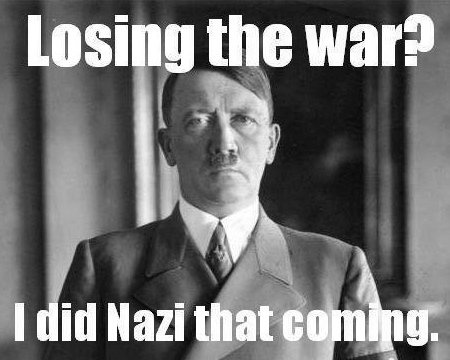
So for today, I wanted to showcase a few of the funnier World War II propaganda posters. You have to love how completely entwined the advertising industry was with the war itself.


And, of course, a modern-day pun.


Tuesday, March 26, 2013

"The Ducktators" - 1942

Cartoon studios created some terrific propaganda pieces during World War II. Posters featuring Mickey Mouse and Donald Duck urged people to get in the fight, buy war bonds, and keep their morale high.

Cartoons were also a great medium to get the message across. The one featured below, "The Ducktators", is from 1942 and tells the story of three "ducktators" - i.e. Hitler, Mussolini, and Tojo. The parody is spot on, and though by today's standards, some of it could be considered racist, it is definitely a product of its time.

Enjoy.


Tuesday, March 12, 2013

BBC Documentary: Nazis: A Warning from History

Though it was made in 1997, the six-part BBC documentary, Nazis: A Warning from History should be required viewing for not just World War II history buffs, but everyone. I don't say this lightly because "required" is a loaded word, and what one person believes should be required is another person's propaganda.

But I will make an exception for this.

Laurence Rees wrote and produced this series, and if you know who Rees is, you'll realize you're dealing with an expert in World War II history. In short, he's brilliant. In addition, Sir Ian Kershaw, one of the most noted historians on the Third Reich, was the historical consultant. What does this mean? It means you will get an objective, honest, no-holds-barred look at the Third Reich from two men who know its history inside and out.

Broken down into six parts, this documentary takes an in-depth look at how the Nazis came to power in Germany, the structure of their government (very disorganized), their relentless propaganda, Hitler's bizarre hold on everyone from children to high-ranking Nazi officials, the origins of the Final Solution, and how Germany became a racist state.

Archival footage, photographs, and recordings of Hitler's speeches sometimes make for hard viewing, but it is necessary. The series also draws on Nazi documents that were discovered in Russia after the fall of the Soviet Union that offer further damning evidence to Nazi atrocities.

Survivors of the Nazis' brutality are interviewed, but it is the interviews with former Nazi party members, Wermacht soldiers, SS men, and even one of Hitler's secretaries that make this a truly original piece of documentary history. Though years have passed, many still justify their behavior, and it is fascinating to see how some skirt the question of responsibility.

One of the conclusions drawn from this documentary is that ordinary Germans were allowed to undertake and express sadistic fantasies against other human beings simply because the very morality of their government not only did nothing to stop it, but encouraged it. When the moral framework of a society disintegrates, those who wish to exercise their dark sides have free reign. Those who want to stand up against it must have incredible courage to do so.

But herein lies the question that continues to plague us all - how could such a cultured nation stoop to such horrors? My theory: Because they allowed the collapse. Indeed, it was easier to let the State do the thinking for them then to think and judge for themselves. Critical thinking skills disappeared as they allowed themselves to be swayed by propaganda and hero worship of a man who sought to control them. They voted to end their democracy, and that is exactly what happened.

What the series does is ask a very important, simple question: Could this happen again? The answer is an unequivocal yes. To this day, despite the mountains of evidence to the contrary, we have those who continue to deny the Holocaust happened, downplay its severity, point to ridiculous Jewish-Bolshevik conspiracies, or continue to harbor anti-Semitism. This is why the Nazis are a warning from history, as this documentary so ably shows, and this is why we can never forget how and why they were able to create hell on Earth.

For those interested in viewing this documentary, it is available on YouTube or on the website, www.documentaryheaven.com